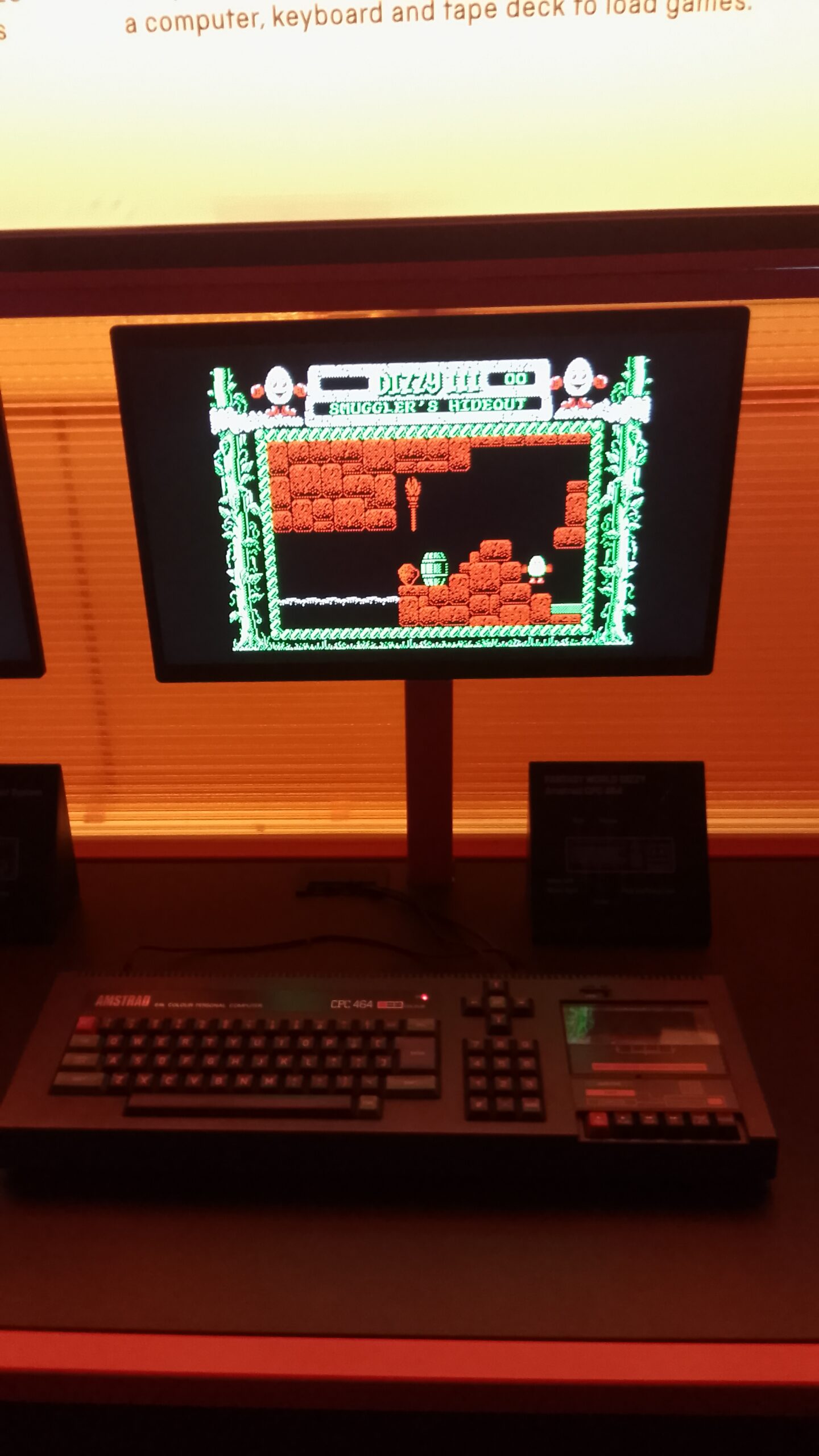
* The photo in this post was taken in the London Science Museum Power Up.
Let me take you back to 1984. The home computer market was a wild frontier. The ZX Spectrum looked like a black slab of rubber with tiny keys that made your fingertips ache. The Commodore 64 was a beige brick that plugged into your family television, which meant you were constantly negotiating with your parents for screen time. And then, from a company better known for budget hi-fi systems, came something completely different. The Amstrad CPC 464 arrived, and it looked like a real computer—the kind you might see at an airport check-in desk or in an office full of serious people in ties. It was Alan Sugar’s grand entrance into the computing world, and he was not messing around.
The Man Behind the Machine
By 1983, Amstrad’s consumer electronics sales were starting to plateau. Alan Sugar, the company’s founder and owner, knew they needed to move into a new sector. He later recalled that they needed to move on and find another sector or product to bring them back to profit growth. He set engineer Ivor Spital to work on a home computer, and Spital came back with a clear conclusion: Amstrad should enter the market, but not with another cheap, plasticky machine that relied on the family telly. Instead, they would build an all-in-one computer with its own monitor, freeing up the television and looking like a grown-up piece of equipment. The result was the CPC 464—the Colour Personal Computer—launched on April 11, 1984, just nine months after the project began. Bill Poel, General Manager of Amsoft (Amstrad’s software division), was so confident in the launch schedule that he famously declared that if the computers were not on shelves by the end of June, he would be prepared to sit down and eat one in Trafalgar Square.
The Hardware That Made It Tick
Under that sleek, keyboard-integrated case, the CPC 464 packed some serious punch for its time. At its heart was a Zilog Z80A processor running at 4 MHz, paired with 64 KB of RAM. Interestingly, the original prototype—codenamed ‘Arnold’—was built around a 6502 processor, the same chip found in the Apple II and Commodore 64, but that plan was abandoned in favour of the Z80, a decision that would shape the machine’s character and software library. The ‘Arnold’ codename stuck around in a different way, too: it became the inspiration for ‘Roland’, the platformer mascot who appeared in several early Amstrad games.
The graphics were handled by a Motorola 6845 chip paired with a custom gate array, offering three distinct display modes that gave developers genuine flexibility. Mode 0 delivered 160×200 pixels with a lavish 16 colours from a palette of 27. Mode 1 gave you 320×200 pixels with 4 colours, which became the sweet spot for many games. And Mode 2 pushed a crisp 640×200 pixels with 2 colours, perfect for business software and word processing. The sound came from a General Instrument AY-3-8912 chip, which provided three channels of audio across eight octaves—plenty of grunt for beeps, bloops, and surprisingly complex game music. A built-in speaker with a volume control sat under the tape deck, and later models added a headphone jack for external speakers.
The All-in-One Philosophy
The CPC 464’s killer feature was not any single component but the way it all came together. The computer, keyboard, and tape deck were fused into a single rugged unit. The monitor—either a colour or a green-screen model—doubled as the power supply, meaning the whole system ran from one wall plug and connected via just two cables. For families who were intimidated by the spaghetti of wires that came with other home computers, this was a revelation. You could pull the CPC 464 out of the box, plug it in, and be loading a game within minutes. No wrestling with a separate cassette player. No arguing about which channel the TV needed to be on. Just a clean, simple, professional-looking setup.
Initial pricing reflected the two monitor options: £199 with the green-screen monitor and £299 with the colour model. That was not cheap—it was pitched as a premium alternative to the Spectrum—but you were getting a complete, ready-to-run system with no hidden extras to buy. After the CPC 6128 launched in late 1985, the price of the 464 was cut by £50, making it even more attractive to budget-conscious buyers.
The Software Library
The CPC 464 amassed a colossal library of games and applications over its lifetime, helped enormously by Amstrad’s aggressive bundling deals and the thriving UK software scene. The built-in tape deck used standard compact cassettes, which kept media costs low and allowed developers to produce games that loaded in a few minutes, give or take the occasional “rewind and try again” frustration. The machine ran AMSDOS, Amstrad’s own operating system, which was embedded directly into the Locomotive BASIC 1.0 ROM. For more serious users, the 464 could also run CP/M 2.2 or 3.0 when paired with an external floppy disk drive—a huge advantage for business applications and word processing, giving it a versatility that pure gaming machines lacked.
The game library was deep and varied. Early titles like Harrier Attack! and Roland on the Ropes showed off the machine’s colourful capabilities, while later ports of arcade hits like Space Harrier, Gauntlet III, and Arkanoid pushed the hardware to its limits. The CPC 464 even got its own version of The Lords of Midnight, Mike Singleton’s epic strategy-adventure masterpiece, and Bruce Lee, a platformer that became a cult classic. The system also became a haven for compilations: the Quattro series from Codemasters packed four games onto a single tape, offering incredible value for money, and titles like Flimbo’s Quest and X-Out demonstrated that European developers had truly mastered the hardware by the early 1990s.
The European Empire
While the CPC 464 never dethroned the Commodore 64 in raw sales figures, it carved out a devoted following across Europe—particularly in the United Kingdom, France, Spain, and the German-speaking markets. In Germany, the machine was manufactured and distributed by Schneider Rundfunkwerke AG under a licensing deal, branded as the Schneider CPC 464. When that partnership ended in 1987, Amstrad inherited a mountain of spare parts, leading to some wonderfully mismatched machines: UK cases fitted with grey Schneider keyboards and German cassette decks, all assembled into working computers and sold across Europe. By the time production ended in 1990, the CPC 464 had sold more than two million units, making it one of the most successful computers in European history.
The Legacy
The CPC 464 was not the most powerful machine of its era. The Commodore 64 had better sprite handling and a more famous sound chip. The Spectrum had a larger UK install base and a fiercely loyal following. But the 464 had something else: it felt substantial. It felt serious. It was the computer your parents bought because it looked like it belonged on a desk, not a toy that would be abandoned under the bed after Christmas.
For a generation of European gamers and programmers, the CPC 464 was their first real computer. It taught them BASIC, introduced them to the joys of loading screens that took five minutes to draw, and gave them hundreds of games that ranged from terrible to timeless. And even now, four decades later, the sight of that green or colour monitor, the clack of those mechanical keys, and the screech of a cassette tape loading still brings a rush of nostalgia to anyone who was lucky enough to own one.
*Did you have a CPC 464 growing up? Were you a Roland fan or did you jump straight to the floppy-drive-equipped 6128? Drop your memories in the comments—and yes, we all remember how long* The Lords of Midnight took to load.

