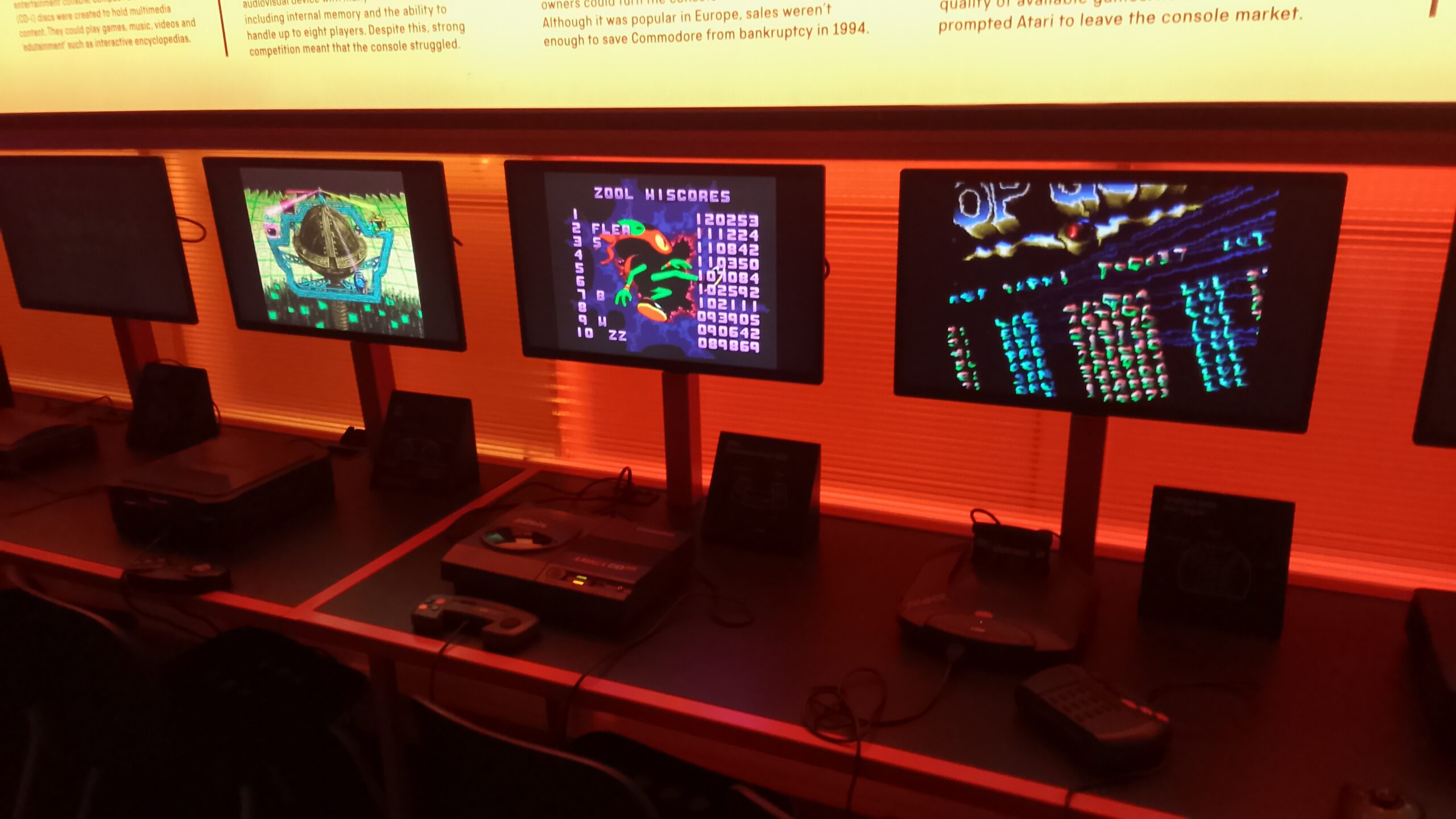
* The photos in this post show consoles of the London Science Museum Power Up.
When we talk about 8-bit gaming, the conversation almost always starts with the NES. And rightly so — Nintendo saved the industry. But there’s another machine that sold just as many units, arguably had better sound and graphics, and quietly dominated living rooms throughout the 1980s. I’m talking about the Commodore 64.
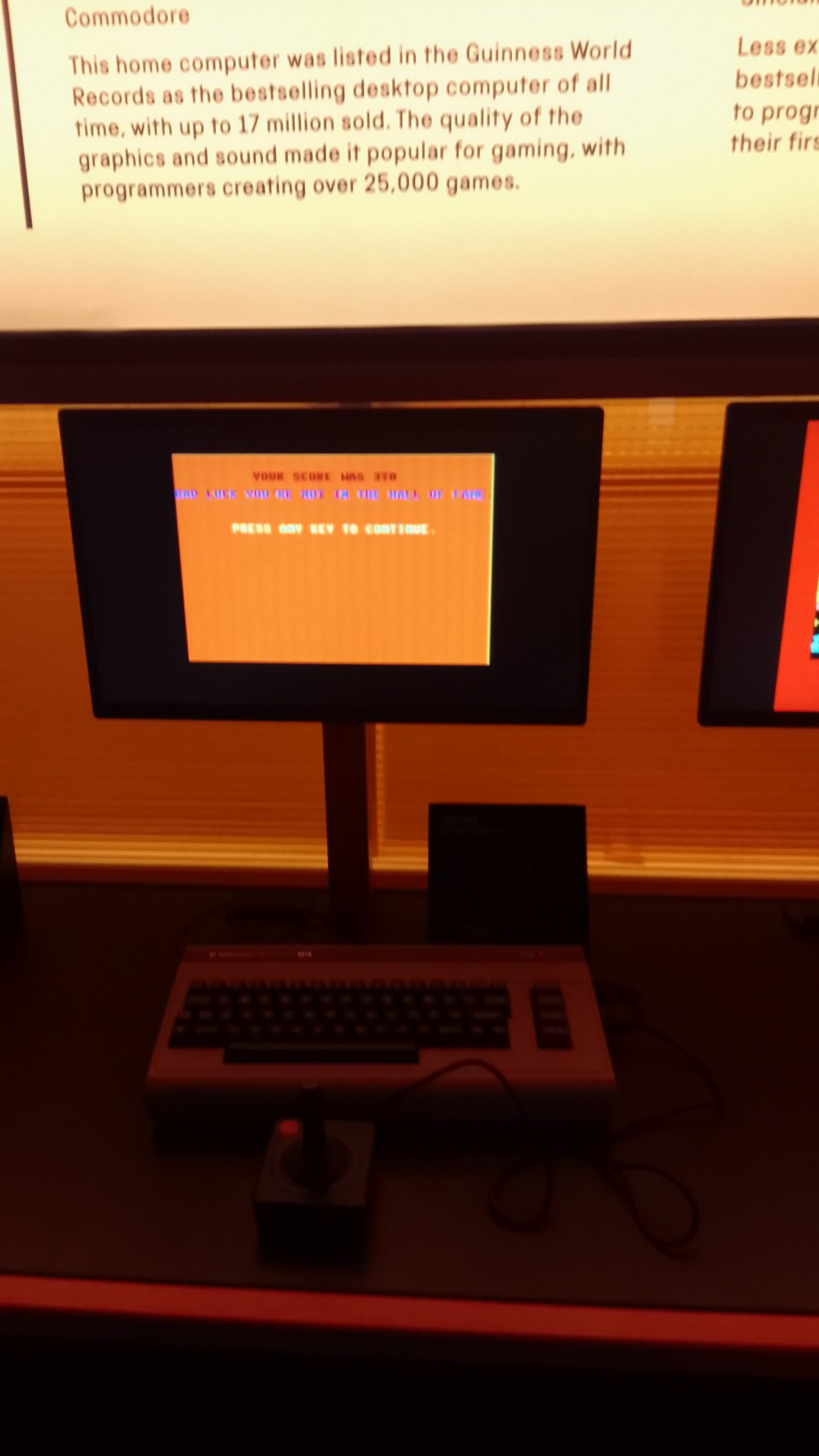
What made the C64 special wasn’t just the price. It was the VIC-II graphics chip and the legendary SID (Sound Interface Device) sound chip. The SID, designed by Bob Yannes (who later founded synthesizer company Ensoniq), featured three channels of audio with multiple waveforms, ring modulation, and filter capabilities. Yannes famously called other computer sound chips “primitive, obviously designed by people who knew nothing about music.” He wasn’t wrong — to this day, the SID has a cult following, with musicians and demoscene artists still composing new music for it. Graphically, the C64 could display sixteen colors, eight hardware sprites, and supported smooth scrolling. It was, for its time, an arcade machine you could also use to type up school essays, if you were willing to wrestle with its notoriously clunky BASIC programming language.
Commodore’s marketing strategy was ruthless. They sold the C64 not just in computer stores but in department stores, discount stores, and toy stores. In 1983, they offered a $100 rebate if you traded in any video game console or computer — a direct attack on the Atari 2600 and the TI-99/4A. This aggressive pricing is widely considered a major catalyst in the video game crash of 1983. Texas Instruments, bleeding money trying to compete, abandoned the home computer market entirely by October 1983. The C64 amassed a software library of nearly ten thousand titles, rivaled only by the Apple II. From The Last Ninja to Impossible Mission to Elite, the machine defined a generation of gaming.
The UK Underdog: Sinclair ZX Spectrum
If the C64 was king in the United States, the Sinclair ZX Spectrum was the champion of the United Kingdom. Released in 1982, the Speccy (as fans affectionately call it) was a marvel of minimalist engineering. It was cheap, cheerful, and exactly what the cash-strapped British market needed.
But here’s the catch: the Spectrum had no hardware support for sprites. That’s right — unlike the C64 and Atari, the Spectrum’s video was handled by a simple ULA (Uncommitted Logic Array) rather than a dedicated graphics chip. All graphics had to be drawn and animated entirely in software, which put enormous strain on the Z80 processor. The Spectrum’s display was also quirky. The screen resolution was 256×192 pixels, but colors were handled by an “attribute buffer” that assigned foreground and background colors to each 8×8 pixel block. This led to the infamous “color clash” or “attribute bleed” — when a colored sprite moved across a different colored background, the colors would bleed into each other, creating a garish mess. Programmers developed all sorts of clever workarounds, including avoiding color altogether, restricting movement to eight-pixel steps, or drawing thick borders around characters.
Despite these technical limitations — or perhaps because of them — the Spectrum fostered an incredibly creative and passionate development scene, particularly in the UK, Spain, and Russia. It sold an estimated 3.6 million units in the UK alone, outselling the C64 in that market. The Spectrum’s legacy is one of ingenuity: making the most with very, very little.
The French Contender: Amstrad CPC
Then there’s the Amstrad CPC (Color Personal Computer), launched in 1984. In France and Spain, this machine was a massive hit, rivaling the Spectrum and C64 in popularity. It shared the same Z80 processor as the Spectrum but featured much more capable hardware. The CPC had a palette of 27 colors and, crucially, could display sixteen of them on screen without the color clash that plagued the Spectrum. In its 320×200 resolution mode, it could display four colors with sharp, clean pixels — ideal for adventure games and detailed graphics. It also featured eighty-column text mode, making it more practical for productivity than either the C64 or Spectrum.
However, the CPC suffered from a reputation problem. Many early games were rushed ports from the Spectrum, failing to take advantage of the CPC’s superior hardware. For years, the machine was seen as a “Spectrum in a fancy case” rather than a powerhouse in its own right. Enthusiasts will tell you that recent homebrew demos and games have finally revealed what the CPC was truly capable of — but in its heyday, it was often overlooked.
The Technical King: Atari 8-Bit Family
Before the C64, there was the Atari 400 and 800, released in 1979. In many ways, these machines were actually more advanced than the Commodore 64. Atari’s custom chips — the ANTIC and GTIA — were years ahead of their time. The ANTIC was a display coprocessor that could execute a “display list” — essentially a small program that controlled how each scanline of the screen was drawn. This meant you could mix different graphics modes on the same screen, create split-screen effects, and trigger interrupts at precise raster positions. The Amiga would later make this technique famous, but Atari did it first. The Atari also featured hardware sprites, called “Player/Missile Graphics,” which were more flexible than the C64’s sprites in some ways. The palette was impressive too: 128 colors (sixteen hues with eight luminance settings) and in some modes up to 256 colors.
So why didn’t the Atari dominate? Two reasons. First, price — the Atari 800 cost $899, significantly more than the C64. Second, marketing — Atari kept technical documentation secret initially, while Commodore published detailed specs and encouraged third-party development. By the time Atari opened up, the C64 had already won the platform war.
The Casualty: Texas Instruments TI-99/4A
The TI-99/4A is the tragic figure of this story. It was actually one of the first 16-bit home computers, using the TMS9900 processor, but in practice it functioned as an 8-bit machine due to memory bus limitations. It had a decent library of games, including some excellent arcade ports. But TI made a fatal error: they underestimated Jack Tramiel. Commodore’s price war bloodied every competitor, but TI was Tramiel’s personal vendetta. Years earlier, TI had nearly bankrupted Commodore in the calculator market. Now, Tramiel returned the favor, dropping the C64’s price until TI was forced to sell the TI-99/4A for just $99 — losing money on every unit. By October 1983, TI exited the home computer business entirely. The 99/4A was discontinued, leaving behind a small but loyal fanbase and a cautionary tale about competing on price with a vertically integrated manufacturer.
The Unsung Hero of Chip Music
Before we wrap up, I have to give a special shout-out to the Atari 8-bit’s POKEY sound chip and the Spectrum and Amstrad’s AY-3-8912. While the SID gets all the glory, the AY chip was used in many arcade machines, giving Spectrum and CPC games a more “authentic arcade” feel. The CPC also featured stereo output, which added depth that the C64 couldn’t match without hardware mods. Meanwhile, POKEY offered four channels of sound and was used in Atari’s arcade games like Gauntlet and Marble Madness. The 8-bit sound wars were real, and every platform had its champions.
The Verdict
So where does that leave us? The Commodore 64 was the best-selling, the Atari 800 was the most technically advanced, the ZX Spectrum was the plucky underdog, and the Amstrad CPC was the overlooked contender. But here’s the thing — they all lost in the end. By 1990, the 16-bit era had arrived. The Commodore Amiga and Atari ST blew all these machines out of the water with true multitasking, millions of colors, and sampled audio. And Nintendo and Sega had proven that dedicated gaming consoles could deliver arcade experiences at home without the complexity of a keyboard and BASIC.
But ask anyone who grew up with a C64, a Spectrum, or an Atari 800. They’ll tell you — those beige boxes weren’t just computers. They were gateways. They taught a generation to program, to create, to push hardware far beyond what the manufacturers ever intended. The demoscene, chip music, and even modern indie game development owe a debt to these machines. So next time you boot up a retro collection or hear that unmistakable SID bassline, pour one out for the Commodore 64 and its scrappy rivals. They built the foundation for everything we play today.

