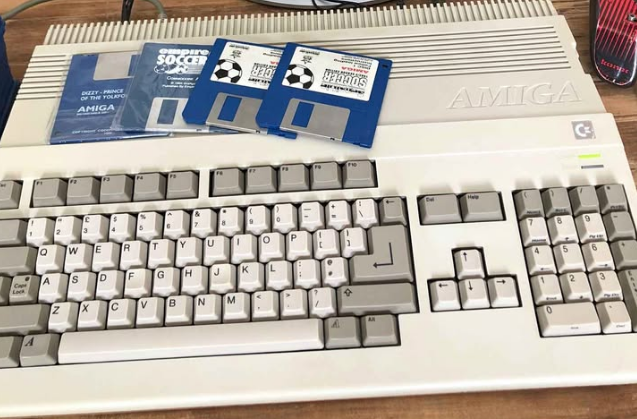
There was a machine that sat at the crossroads of art and engineering, a computer that didn’t just play games but inspired an entire generation to make them. The Commodore Amiga, born in 1985, was unlike anything that came before it. With its custom chipset—Agnus, Denise, and Paula—it offered hardware-level graphics and sound capabilities that seemed almost magical. And for those who dared to learn its secrets, the Amiga became not just a computer, but a canvas.
Game programming on the Amiga was a unique experience, shaped by the machine’s architecture, its passionate community, and a remarkable array of development tools. From the bare-metal power of assembly language to the beginner-friendly embrace of BASIC dialects, the Amiga offered a path for everyone who dreamed of creating their own worlds.
The Amiga Difference: Hardware That Demanded to Be Explored
What set the Amiga apart from other computers of its era was its custom chipset. Instead of relying on the main CPU to handle everything, the Amiga offloaded graphics, sound, and memory management to dedicated processors. This architecture allowed for smooth parallax scrolling, hardware sprites, four-channel stereo sound, and a blitter chip that could move blocks of graphics data faster than the CPU could manage.
For game programmers, this was both a gift and a challenge. The gift was power—the ability to create games that looked and sounded like arcade machines. The challenge was complexity. To truly harness the Amiga’s capabilities, you had to understand its hardware intimately. You had to know how to set up copper lists to change display colors mid-screen, how to program the blitter for fast sprite manipulation, and how to manage the interplay between the CPU and the custom chips.
Many games, especially in the early years, bypassed the operating system entirely and wrote directly to the hardware. This approach delivered the speed and smoothness that players demanded, but it came at a cost. Programs that took direct hardware control often broke on newer Amiga models or with updated versions of the operating system. It was a trade-off that every Amiga developer had to navigate.
The Assembly Language Era: Getting Close to the Metal
For the first several years of the Amiga’s life, assembly language was the undisputed king of game development. If you wanted to create a commercial-quality game, you learned 68000 assembly.
Assembly was the language that spoke directly to the Amiga’s soul. It allowed programmers to squeeze every last cycle of performance from the machine, to craft copper lists that produced rainbow effects and split-screen displays, and to orchestrate the blitter with surgical precision. Games like Shadow of the Beast, Turrican, and Sensible Soccer were products of this assembly-driven era—titles that pushed the hardware to its limits and became legends in their own right.
The development environment for assembly programmers typically consisted of professional assemblers that included an editor, assembler, linker, and debugger all in one package. These tools were powerful enough for commercial development yet accessible enough for dedicated hobbyists.
But assembly was not for the faint of heart. It required understanding memory management, processor architecture, and the intricate details of the Amiga’s custom chips. The learning curve was steep, and the debugging process could be brutal. Yet for those who persevered, assembly offered a level of control that no other language could match.
Today, the assembly tradition lives on. Modern guides continue to teach developers how to create complete games using assembly language, with contemporary tools and emulators. The techniques may be decades old, but the satisfaction of making the Amiga’s hardware dance remains timeless.
The BASIC Revolution: AMOS and Blitz BASIC
If assembly was the language of the professionals, BASIC was the language of the dreamers. And in the early 1990s, two BASIC dialects emerged that transformed the Amiga game development landscape: AMOS and Blitz BASIC.
AMOS: The People’s Choice
AMOS BASIC was created by François Lionet and Constantin Sotiropoulos and published in 1990. It was a descendant of STOS BASIC for the Atari ST, and it brought the same philosophy to the Amiga: make game development accessible to everyone.
AMOS was remarkable for its focus on media and game creation. It included high-level functions for loading and manipulating images, animations, and sounds, all with syntax that was easy to learn. Even more impressively, AMOS came with AMAL—the AMOS Animation Language—a compiled sprite scripting language that ran independently of the main program, allowing for complex sprite animations without slowing down gameplay.
The original version of AMOS was an interpreter, which meant code ran slower than compiled languages. But AMOS was exceptionally fast for an interpreted language—fast enough that an extension called AMOS 3D could produce playable 3D games even on the original 7 MHz Amiga 500. Later, a compiler was released that further increased speed.
AMOS also allowed programmers to include inline assembly code, giving them a path to optimize performance-critical sections while still enjoying the productivity benefits of BASIC.
Blitz BASIC: The Competitor
AMOS’s main rival was Blitz BASIC, published by Acid Software. Like AMOS, Blitz BASIC offered structured code, high-level multimedia functions, and the ability to create demanding games without dropping into assembly. The two languages competed fiercely, each with its passionate advocates, and together they brought game development to thousands of Amiga users who might otherwise never have written a line of code.
The Legacy of AMOS
AMOS was used to create a surprising number of commercial and shareware games. Titles like Flight of the Amazon Queen, Jetstrike, and the Valhalla trilogy were built with AMOS. It became the tool of choice for bedroom coders, educational software developers, and aspiring game designers who wanted to see their ideas come to life without spending years mastering assembly.
Even today, AMOS retains a dedicated following. The source code was released under an open-source license around 2001, and a small but passionate community continues to use AMOS, creating new games for a platform that refuses to die.
The C Language: Striking a Balance
For developers who wanted more power than BASIC but found assembly too daunting, C offered a middle ground. The Amiga had robust C compilers that allowed programmers to write relatively portable code while still accessing the hardware when needed.
C became the language of choice for many productivity applications and an increasing number of games. It offered better performance than interpreted BASIC while being far more readable and maintainable than assembly. For developers who wanted to build larger, more complex projects, C was often the sensible choice.
In recent years, new C-based frameworks have emerged for Amiga development. These frameworks provide lightweight, hackable environments for creating high-performance games using C, with thin hardware abstraction layers designed to be as documented and transparent as possible. These modern frameworks show that C remains a vital language for Amiga development, bridging the gap between the machine’s legacy and contemporary development practices.
The No-Code Movement: Game Creators and Construction Kits
Not everyone wanted to write code. For those who dreamed of making games but didn’t want to learn programming languages, the Amiga offered another path: game creation software.
The Shoot-‘Em-Up Construction Kit was one of the earliest and most famous examples, allowing users to design scrolling shooters without writing a single line of code. The 3D Construction Kit brought similar accessibility to first-person adventure games.
Today, this tradition continues with modern game creation tools designed specifically for Amiga systems. These tools empower users to create games without programming knowledge, offering integrated development environments that run directly on the Amiga. They include features like parallax scrolling, copper gradients for extra colors, integrated sound generation, and even network play between two players. These are tools designed for hobbyists who want to create games with the true Amiga feeling, without the learning curve of traditional programming.
The Development Ecosystem: Tools of the Trade
Creating a game on the Amiga required more than just a programming language. Developers built entire ecosystems of tools to support their work.
Graphic editors were essential for creating sprites, backgrounds, and other visual assets in the Amiga’s native graphics format. Audio tools helped create the mod music and sound effects that defined the Amiga sound. Asset converters transformed these creations into raw data that could be loaded directly into games.
For many developers, the workflow became hybrid. Write code on a modern PC with a powerful editor, use emulators for testing, and maintain source code with version control. Then, when the game was ready, run it on real hardware for final testing. This blend of old and new has made Amiga development more accessible than ever.
A Legacy That Lives On
The Commodore Amiga was commercially discontinued in the mid-1990s, but its spirit never died. Today, a vibrant community of developers continues to create new games for the platform. Demoscene groups still release stunning demonstrations of what the hardware can do. Online archives host thousands of programs, tools, and games. And every year, new titles are released—some on physical floppy disks, others as digital downloads for emulators and real hardware.
What made Amiga game programming special was never just the hardware or the languages. It was the culture—a community of creators who shared code, swapped techniques, and celebrated each other’s work. It was the feeling of making something from nothing, of seeing your sprites scroll across the screen, of hearing your music play through Paula’s four channels.
Whether you wrote in assembly, BASIC, or C, whether you used a construction kit or built everything from scratch, you were part of something unique. The Amiga didn’t just play games. It invited you to create them. And for those who answered that invitation, it offered a journey that many are still traveling today.
From the copper lists of assembly programmers to the drag-and-drop simplicity of modern game creators, from the interpreted ease of AMOS to the elegant frameworks of contemporary C development, the Amiga remains a platform where creativity meets technology in the most beautiful way. The languages may have changed, the tools may have evolved, but the spirit endures.
And somewhere, in a workshop or a bedroom, someone is still sitting down at an Amiga, opening a text editor, and starting to code the next great game. Just as they have been for forty years.

